
The short version
- Packaging is the idea, the title and the thumbnail. We add the hook, because the hook keeps the promise the package makes.
- Find ideas by looking for outliers: videos that did far better than their own channel's average.
- The title and thumbnail work as a pair. The thumbnail adds to the title. It never repeats it.
- Show the moment the thumbnail promised within the first 10 to 30 seconds.
- Rules of thumb disagree, so test. YouTube's own testing tool picks winners by watch time, not clicks.3
We have one rule that comes before everything else: we don't write a script, outline or shot list until the title and thumbnail are approved.
It sounds backwards. But the package is the promise you make to a stranger scrolling past. If you can't write that promise clearly, the video isn't ready to film.
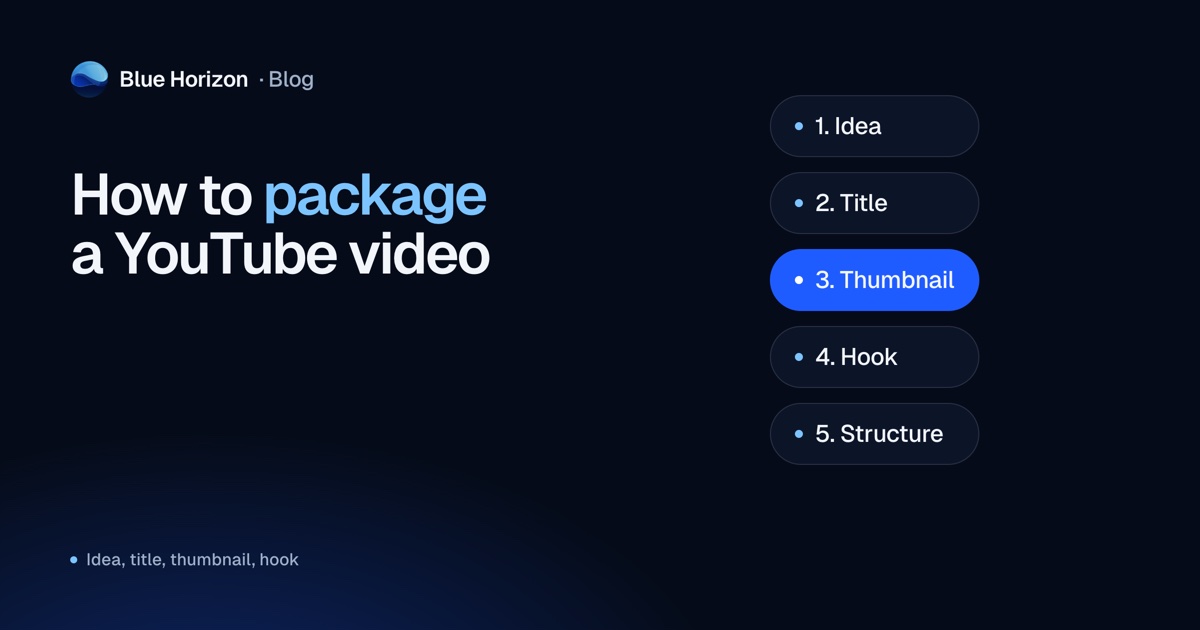
YouTube's own team describes packaging as three things: the title, the thumbnail and the idea.1 We work through it in five steps.
The five steps, in order
Step 1: The idea
Most experts start with "what should I talk about?" We start with "what is already working for this kind of viewer?"
We look for outliers: videos that did far better than their own channel's usual. A video that gets 10 times its channel's normal views on a 50,000-subscriber channel tells us more than a video that did slightly above average on a 5-million-subscriber channel. The big channel's numbers are mostly its size. The outlier's numbers are the idea.
Here's the process:
- Pick 5 to 10 channels your buyers already watch.
- Look at their last 90 days and flag videos at 3 times the channel's usual views or more.
- Name what made each one work: the topic, the format or the angle.
- Check that people search for it. Start typing it into YouTube's search bar and see what it suggests.
- Keep only the ideas you can tell from your own experience.
That last step is the one people skip. Every idea has to be something only you could say. If a topic is hot but you don't have a real story about it, it isn't your video yet. The comments under your own videos count too. An unanswered viewer question is an idea.
Step 2: The title
Our title rule is honest curiosity. Make people want to know more, without promising money or "you won't believe what happened."
We write 10 titles in five styles, then pick the best three:
- How-to: how to do a specific thing
- Story: something that happened to you
- Opinion: a belief your field gets wrong
- Mistake: what to stop doing
- Specific result: a real outcome with real numbers
Then we check each one against a simple test: would a VP of Sales click this without feeling baited? If it feels like a trick, it's out.
Some real before-and-afters from our work with Peter Ahn, a Chief Customer Officer and tech sales coach:
- "...negotiation hacks" → "Negotiation approaches that build trust." Peter didn't like the word "hacks" for this one. He was right. His buyers want trust, not tricks.
- "I trained at the Hoop House" → "I'm 40 and I still get coached every week." The first version is about a place. The second is about an idea his audience cares about: always staying coachable.
- "Sales Isn't a Presentation" → "Why Founders Find Sales So Intimidating." Same video. The new title names who it's for and the feeling they already have.
Notice none of them are clever. They say it the way the buyer would.
Step 3: The thumbnail
The title and thumbnail are read together in about a second. So they have to work as a pair.
A title and thumbnail working as a pair
The first thumbnail draft said "Artful Negotiation Approaches." Too close to the title, so it added nothing. "The art of negotiation" gives the idea, and the title gives the promise.
Our thumbnail rules:
- Add, don't repeat. Three or four words that build on the title.
- One face, one feeling, one focal point. If you need to explain it, it's too busy.
- Confirm the click. Use a real moment from the video, and show it again in the first 10 to 30 seconds so the viewer knows they're in the right place.
- Borrow structure, not hype. Copy the layout of thumbnails that work in your space. Skip the red arrows and shocked faces.
What about text vs no text, or face vs no face? The research honestly disagrees. One study of 300,000 videos found thumbnails with text got about 19% fewer views.7 Another, of 507,000 videos, found breakout videos were a bit more likely to have four to six words of text. It also found faces on 84% of breakouts and 82% of underperformers, so a face is normal, not an edge.8
So test. YouTube's "Test & Compare" tool lets you try up to three titles or thumbnails on the same video. It picks the winner by watch time, not clicks.3 That's the right way to judge it. A thumbnail that gets clicks but loses viewers in a minute isn't winning.
Creators have run more than 40 million title and thumbnail tests this way, and YouTube says testing different video openings is coming next.6 Packaging is becoming something you measure, not guess.
Step 4: The hook
The hook has one job: pay off what the title and thumbnail promised, fast.
YouTube measures this. Its "intro" number shows the share of viewers still watching at 30 seconds. YouTube's own first fix for a weak intro is making sure the title and thumbnail match what the video delivers.4 Videos where more than half of viewers are still there at 30 seconds count as above typical.5
We learned this the direct way. A viewer once commented that one of our titles felt "a bit misleading." The video was good. The package promised something slightly different. Now the rule is simple: the title has to match what the video actually covers, and the thumbnail's moment shows up in the first 30 seconds. If it comes later, we tease it in the opening.
Step 5: The structure
For a 12 to 20 minute video, we use a simple shape:
- Hook (first 30 seconds): keep the promise.
- Context: why you're the person to listen to, based on what you've done, not what you claim.
- Three points: each one is a story followed by something the viewer can do.
- A second open question around 70% of the way in, so people don't leave once the first promise is paid.
- One ask at the end. Just one.
How to judge your packaging
- Compare to yourself, not to others. Half of all channels have a click-through rate between 2% and 10%, and videos shown widely naturally get lower rates.2 YouTube's team has said click-through rates aren't comparable across channels.9 Compare each video to your own usual.
- Separate packaging problems from topic problems. YouTube suggests checking how a video does with your subscribers. If your own subscribers don't click, it's probably the topic. If they do and strangers don't, it's probably the package.10
- Changing a title won't trick the algorithm. YouTube says there's no boost just for changing a title or thumbnail.11 A better package can still help, because more of the right people click.
- Be patient. Don't judge a video at day 30. Good expert videos keep getting found for years.
Want to see this process work on a real video? Read how a 20-minute talk got 25x its channel's usual views.